The Quiet Revolution
When the Lesson Ends, What Do They Actually Carry Home?
A student walks into your classroom on a Tuesday morning. She sits in her usual seat. She opens her notebook. She does not say a word for the entire hour. You notice, distantly, that she has been quieter than usual for a few weeks, but you have a syllabus to finish and forty-three other students to read, and the lesson goes on.
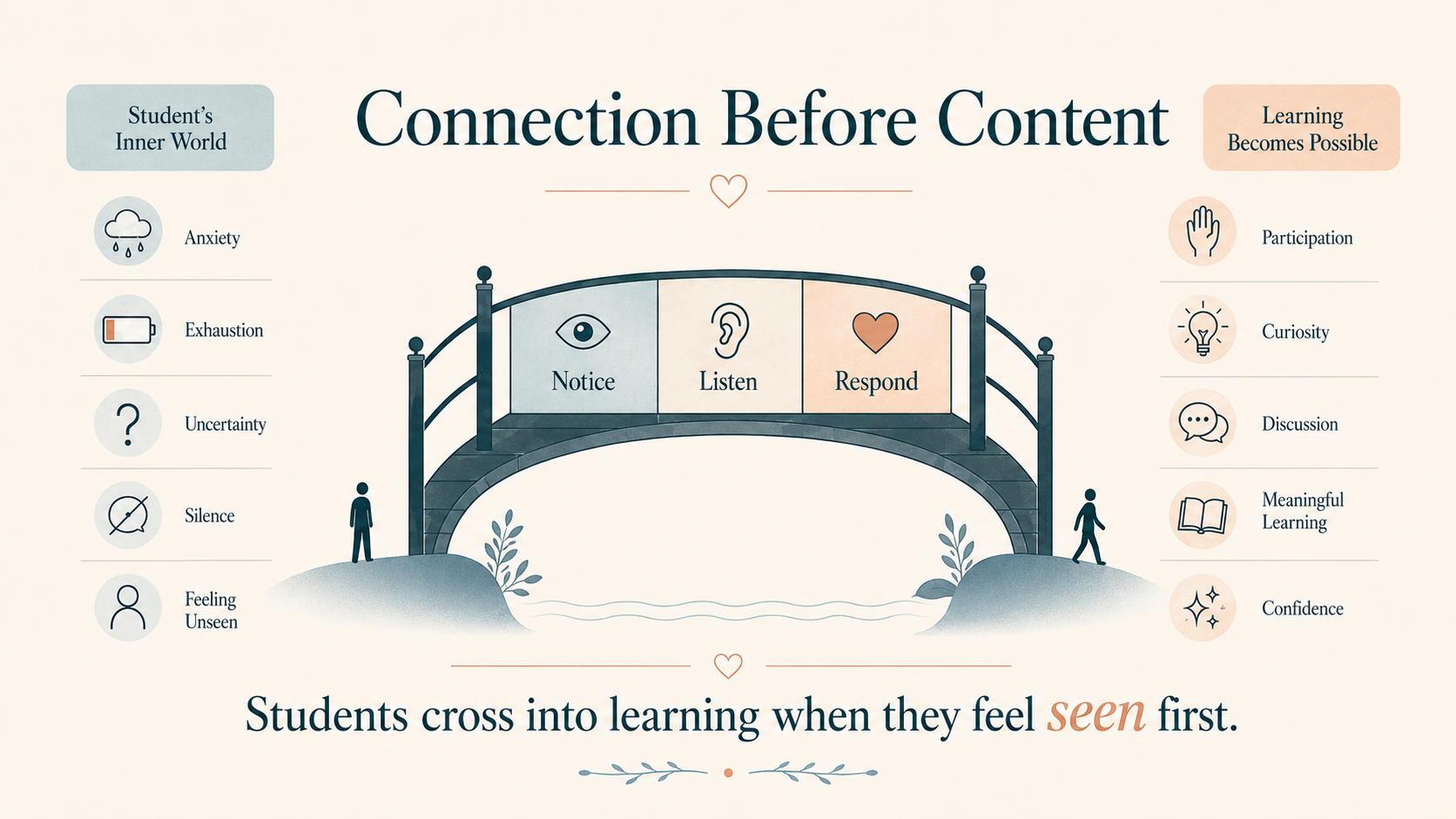
Three months later, ask her what she learned in your class that term. She might remember a fact or two. She might remember the test. What she will almost certainly remember, with surprising clarity, is whether she felt seen.
This is the uncomfortable thing about teaching. Long after the lesson plans are forgotten, what students carry forward is the emotional climate of the room. Whether they were welcomed or tolerated. Whether their confusion was treated as data or as failure. Whether they were a person to you, or a number on a list.
Care Pedagogy is the name we give to teaching that takes that fact seriously. Not as a nice-to-have. As the actual ground floor of the work.
A Scene From the Staffroom
The Student Who Stopped Submitting
Scenario | You have probably lived this one
A student in your class, a strong one historically, suddenly stops submitting work. The first instinct, trained into us by years of marking schemes and accountability dashboards, is to send the firm email. Tighten the consequences. Remind him of the grade implications.
The care pedagogy instinct is not to abandon those things. It is to add a different first move. A short conversation, off to the side. "I have noticed you have not been submitting. I am not here to tell you off. I just wanted to check in. Is everything alright?" Not a counselling session. Just a door, gently opened.
Sometimes the answer is mundane. Sometimes it is something the student has been carrying alone for weeks. Either way, the next two months of that student's experience in your class have just been quietly transformed by the fact that someone noticed.
Notice what that conversation did not require. It did not require a counselling qualification. It did not require an extra hour you do not have. It did not require lowering the academic bar. It required about ninety seconds of attention.
That is the bit people miss when they hear the words care pedagogy and immediately think it is a vague, time-consuming ideal. Most of it is not extraordinary. Most of it is small, deliberate human moves, made consistently, by someone who has decided that the relationship is part of the job.
In Practice
Seven Small Moves That Quietly Change Everything
None of these require a curriculum overhaul. All of them require choosing.
01
Open With a Check-In
A thirty-second emotional weather report at the start of the lesson is not lost time. It tells you who arrived in the room today and who showed up only physically. You will teach better with that information than without it.
02
Make Mistakes Cheap
If wrong answers are punished by social embarrassment, students stop offering any. A psychologically safe room is one where being wrong is part of learning, not evidence of inadequacy. Model that yourself first.
03
Learn Their Names. Properly.
Knowing who someone is, what they care about, what they are good at, is not optional pastoral fluff. It is the cheapest, highest-leverage relationship investment any teacher can make. Students perform differently for adults who know them.
04
Listen Before Solving
When a student opens up about a struggle, the instinct is to fix. Often what is needed first is simply to be heard. Solutions land better in a student who feels understood. They bounce off one who does not.
05
Reward Effort, Not Only Results
Classroom cultures that obsess over the grade alone teach students that worth is conditional. Acknowledge growth, perseverance, the willingness to ask the awkward question. Those are the habits that survive long after the test.
06
Notice the Quiet Ones
A silent classroom is not necessarily a comprehending one. The student who never speaks may be the one who needs the most. A short private word at the end of a lesson can do what no class discussion will.
07
Model Your Own Humanity
When you have a difficult day and name it briefly, you give students permission to be human too. Calm under pressure, kindness under provocation, patience when the lesson plan implodes. They are watching all of it.
The Honest Bit
Can We Actually Do This in the Real World?
It would be dishonest to write any of this without acknowledging the obvious. Most teachers are exhausted. Most lecturers are juggling research outputs, administration, and classes that have grown larger every year. Most schools and universities operate under accountability regimes that measure what is countable and ignore what is not.
In that climate, telling teachers to care more can feel cruel. They already care. That is part of why they are tired.
So this is the bit policymakers need to read carefully. Care pedagogy is not free. It does not happen by exhortation. If we want classrooms where students feel seen, we have to build institutions where teachers are seen too. Reasonable class sizes. Time genuinely protected for relationship work, not swallowed by reporting. Wellbeing support that is real, not symbolic. Career pathways that do not punish the teacher who slows down to talk to a struggling student.
You cannot extract care from a workforce you are systematically depleting. If your policy levers reward only what is measurable, you are quietly telling teachers that the unmeasurable bits, the relational bits, the human bits, do not count. They will respond accordingly. Then we will all wonder why our students feel disconnected.
For the individual educator, the question is narrower and more honest. You cannot fix the system from inside one classroom. What you can do is decide what kind of room your room will be. The thirty-second check-in. The quiet word at the end of a lesson. The deliberate slowing down to listen rather than to respond. These are not heroic acts. They are choices, available most days, taken or not taken.
Care pedagogy is not asking anyone to do extraordinary things. It is asking us to do ordinary things on purpose.
For The Reader
Five Questions Worth Sitting With
Read these slowly. Honest answers, not professional ones.
- If a student in your class went quiet for three weeks, would you notice in time, or only when the marks started to slide?
- What does your classroom culture reward more loudly, the right answer or the courage to ask the awkward question?
- If you could remove one institutional pressure that currently makes care harder to give, what would it be, and why has nobody removed it yet?
- When was the last time a student told you, in some form, "thank you for noticing"? What had you done that prompted it?
- If your school or university disappeared tomorrow, what would former students say it had given them, beyond a transcript?