Feature Essay
The Human Algorithm
Paulo Freire wrote about education as either an instrument of compliance or a practice of freedom. Half a century later, our newest classroom assistant is forcing us to pick a side.

Paulo Freire wrote about education as either an instrument of compliance or a practice of freedom. Half a century later, our newest classroom assistant is forcing us to pick a side.
I am no longer in the classroom in the old sense. These days, much of my work is with educators, helping them think through how AI can support teaching and learning without quietly hollowing out the very work that makes teaching human.
One question I hear often in workshops sounds innocent enough: “What is the best prompt to mark these essays for me?” I understand the pressure behind it. Marking is heavy, slow, and sometimes painfully repetitive. But that question also worries me, because the act of reading a student’s work is not merely administration. It is where teaching often happens.
When a lecturer reads closely, notices a fragile argument, senses a borrowed voice, or asks why a student has avoided the difficult part of the question, something pedagogical is taking place. If AI is used only to outsource that encounter, we may gain speed but lose the moment where judgement, care, dialogue, and formation meet.
So this piece is not an anti-AI argument. It is an invitation to ask a harder question: are we using AI to deepen teaching, or to escape from the part of teaching that asks us to be most present?
Paulo Freire wrote Pedagogy of the Oppressed in exile, having been driven out of Brazil by a military regime that did not appreciate his habit of teaching peasants to read in ways that also taught them to ask awkward questions. The book has had a strange afterlife. Required reading in some teacher training programmes, dismissed as outdated in others, half-remembered by most of us who studied it once and then got on with the actual job of teaching.
It is worth pulling off the shelf again. Not for nostalgia. For diagnosis.
Freire's central image was the bank. He argued that conventional education treats students as empty accounts into which the teacher deposits authorised knowledge. The student receives. The teacher transmits. The system functions efficiently. Nobody, in this arrangement, is required to think very hard about why the deposits are what they are, or who decided what counted as worth depositing.
Against this, Freire proposed something he called problem-posing education. Teacher and student as co-investigators. Knowledge not as a thing handed down but as a thing built between people who are trying, together, to make sense of the world. He called the developmental movement this produced conscientização. Critical consciousness. The capacity to read not just the words on the page but the conditions that shaped them.
You can see why a Brazilian junta did not love this. You can also see why, fifty-something years later, the question is back.
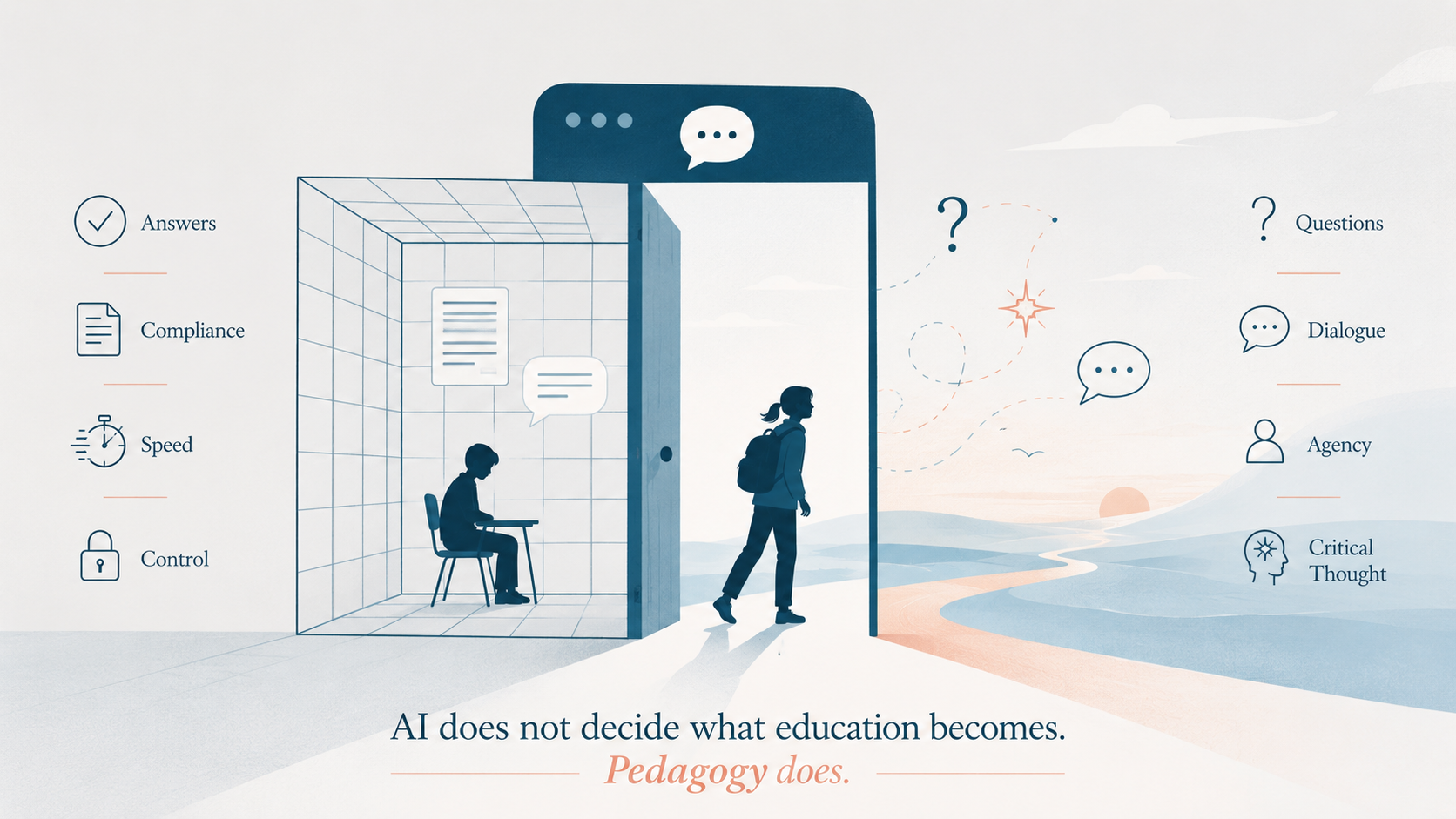
Here is the awkward thing about large language models in a Freirean reading. They are extraordinarily good at the banking model. You ask. They deposit. The deposit is well-formatted, plausible, and arrives in seconds.
For the student in a hurry, this is irresistible. The traditional banking classroom at least required the student to sit through the lecture, take some notes, and survive the assignment. The new arrangement removes even that small friction. The essay arrives pre-thought. The reading summary arrives pre-read. The argument arrives pre-argued.
And here is what Freire saw clearly half a century ago, in a context that had nothing to do with computers. When the deposit replaces the inquiry, something stops forming. The student becomes, in his phrase, an object rather than a subject, manageable and adaptable, and increasingly unable to name the world for themselves because somebody else has done the naming first.
The danger is not that students use AI. The danger is that they outsource the part of education that is actually doing the teaching. The struggle. The mess. The moment of sitting with a problem you do not yet know how to solve. Skip that step and you have not learned faster. You have not learned.
The other half of the bind is institutional. Universities have spent twenty years justifying themselves to ministries and parents through the language of employability. Return on investment. Industry alignment. Graduate outcomes. The vocational pipeline.
None of this is wrong, exactly. Graduates do need jobs. Parents do need to see value for the fees. The problem is what we lose when employability becomes the only frame we have.
Freire would call it domestication. We train students to fit a world that other people have designed, rather than to question whether the world should look that way. We produce, in his words, efficient objects rather than critical subjects.
The irony, in 2026, is brutal. The technical tasks we have been training students to perform are the very tasks AI now does faster and cheaper. The narrowly employable graduate may turn out to be the most obsolete graduate. The student who can think, argue, weigh competing values, and decide what is worth doing in the first place is the one the machine cannot easily replace.
If your only contribution to the labour market is technical competence, you have just entered a competition with a system that does technical competence at scale, twenty-four hours a day, for the price of an API call. The university that trains only for that market is preparing graduates for a race they cannot win.
A student turns up to the tutorial with a six-page essay on a topic she has, by any conventional measure, mastered. The argument has structure. References are real and the conclusion is defensible. You ask her, conversationally, which part she found most difficult.
She hesitates, then gestures vaguely at the middle. She offers a phrase that sounds borrowed because it is.
You ask her what she would say to someone who disagreed with her main thesis. The conversation thins. The eyes drift. The essay, which is a perfectly good essay, was never hers in any sense Freire would recognise. The deposit was made. The bank balance is excellent. Nothing has been built.
This is not, to be clear, a story about cheating. Plenty of students who get this result did not technically break a rule. They used the tool the way the tool was designed to be used. They asked. It answered. They tidied. They submitted.
The pedagogical problem is upstream of any honour code. We have built an entire educational architecture around products, marks given for finished outputs, and then handed students a tool that generates finished outputs on demand. The architecture and the tool are working exactly as designed. The student is the thing being quietly cancelled.
None of these ban the tool. All of them change what it is asked to do.
Freire's most uncomfortable claim, and the one most likely to make a senior administrator shift in their seat, was that education is never neutral. It either reinforces the existing arrangement of power or it equips people to question it. There is no middle setting. The neutral-sounding curriculum is itself a choice, taken for the people who designed it, paid for by the people who funded it.
The arrival of generative AI does not change that. It just makes it harder to ignore.
When a model trained on a particular slice of the internet, optimised by a particular company, hosted in a particular jurisdiction, becomes the de facto first stop for every research question a student has, somebody's worldview has just been quietly installed at the centre of the curriculum. Pretending that is a technical matter, separate from the political one, is the same move every dominant ideology has ever made.
The pedagogical task, then, is also political. Not in the partisan sense. In Freire's sense. It is the work of helping students see the arrangement they are inside, so they can decide for themselves what to do about it.
None of this is a reason to throw the tools out. They are extraordinary, they are not going away, and the students who learn to use them well will have advantages the students who refuse will not. The reason is to be honest about what the tools can and cannot do, and to design teaching that uses the tool's strengths without ceding the part of education that only humans can still do for each other.
That part has not changed since 1968. It is the slow, friction-filled, sometimes uncomfortable work of helping a young person become someone who can think for themselves. Freire wrote about it in exile, on a typewriter, in a country that did not want him doing it. The job is the same. The temptation to skip it has just become a great deal more sophisticated.
Read these slowly. Honest answers, not polished ones.