The Crossroads
A Question Our Universities Have Been Allowed to Avoid
Malaysian public universities are at a difficult, necessary crossroads, and most of us inside the system know it. For decades the steering wheel has been held by labour market forecasts, accreditation bodies and economic planners. That is not unreasonable. Public universities are heavily subsidised, taxpayers pay the bill, and the country fairly expects graduates who can do the work the nation needs done.
The problem is what gets quietly dropped along the way.
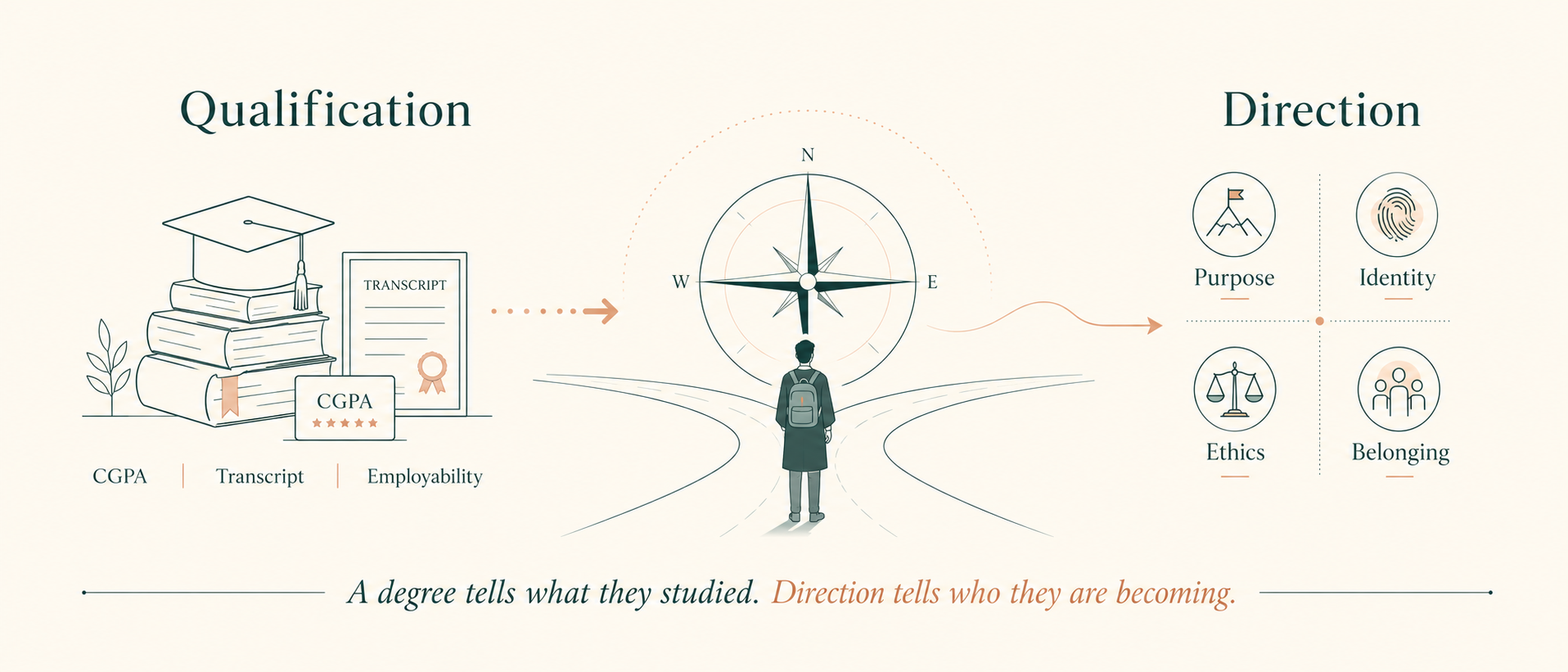
Across Malaysian campuses, most of our students can tell you, with surprising precision, what degree they are pursuing. Far fewer can tell you, with any clarity, who they are becoming. That is not a small gap. That is the entire developmental task of undergraduate education going unattended.
Educational psychologists have known this for a long time. Marcia Baxter Magolda calls it self-authorship, the slow movement of a young adult from leaning on external validation to building beliefs and commitments from inside. Arthur Chickering and George Kuh have spent careers showing that university is not a content-delivery system. It is a setting in which meaning, values and a workable sense of self are supposed to take shape. Knowledge is part of it. Knowledge is not the whole of it.
Care about identity does not mean lowering academic standards. It means recognising that a graduate without a coherent sense of self, ethics and professional purpose is fragile, no matter how high the CGPA. The technically brilliant doctor with no empathy. The decorated engineer with no civic sense. We have all met them. We have all wondered how they got through.
This is uncomfortable to say out loud at a faculty meeting, because most of our institutional machinery still runs on an older logic. Curriculum delivery. Examination. Accreditation. Graduate employability statistics. Identity formation tends to be filed under student affairs, somewhere down the corridor, somewhere not our problem.
It is increasingly our problem.
What Actually Works
Identity Is Not Formed by Listening. It Is Formed by Doing, Struggling, Reflecting.
If there is one robust finding in the student development literature, it is this. The undergraduate experiences that genuinely shift identity, deepen engagement and sustain motivation are the ones where students leave the lecture theatre and meet a real human context. Service learning. Undergraduate research. Internships with mentorship that actually mentors. Capstone projects that demand integration. Learning communities where students wrestle with each other and a problem at the same time.
George Kuh's body of work on high-impact practices, often shortened to HIPs, has been telling us this for two decades. Authentic engagement plus structured reflection produces the developmental movement that lectures alone cannot. The Association of American Colleges and Universities has been similarly consistent. Students learn who they are becoming when they have to act, mess up, think about it, and try again.
A Scene You Have Probably Witnessed
An engineering student spends a semester working with a rural community on a water access project. She arrives expecting to apply textbook solutions. She leaves with an entirely revised understanding of what engineering is for, who it serves, and what kind of engineer she wants to become. None of that was in the syllabus. All of it was the actual learning. The technical content stuck in a way it had not stuck in any prior course.
That is not a feel-good anecdote. It is the developmental literature, in working clothes.
Malaysia, to its credit, made the structural call early. Since 2015 the Ministry of Higher Education has mandated Service-Learning Malaysia, what most of our institutions know as SULAM, as part of undergraduate education across public universities. The policy direction is the right one. Studies of Malaysian undergraduates have consistently found service-based learning to be among the most engaging pedagogies students encounter. When medical students confront healthcare inequities, when education students facilitate learning with marginalised youth, when business students sit across a table from a struggling cooperative, the simplistic assumptions get destabilised. That destabilisation is the moment professional identity actually starts forming.
The honest follow-up question is whether the mandate, a decade in, has translated into deep, mentored, properly debriefed engagement, or whether on too many campuses it has been absorbed into the existing tick-box ecology. The policy did its part. Implementation has been uneven.
Identity is not transmitted. It is constructed, in the friction between what a student thought they knew and what the real world has just shown them.
Globally, the universities taking this seriously have moved well past pilot projects. Stanford talks openly about purpose learning and reflection in undergraduate pathways. Waterloo embeds co-operative education tied to e-portfolios that force students to articulate what they are learning about themselves. Clemson maps student participation in HIPs across their entire undergraduate experience, so that no one slips through with a degree but no developmental encounter. The recurring institutional insight is that employability and identity development are not in tension. They reinforce each other.
Malaysia has the policy language. We have not yet, in most institutions, made the structural moves.
The Lecturer Question
Every Academic Shapes Identity, Whether They Mean To or Not
Here is the part many of us in the academy do not love hearing. Identity-oriented teaching cannot be outsourced. Not to student affairs. Not to the counselling unit. Not to the new wellbeing portfolio nobody has time for. Every lecturer, in every class, is shaping student identity, intentionally or otherwise, through the way they design a syllabus, run a tutorial, give feedback and treat the human in front of them.
Most of us were trained as disciplinary experts, not developmental educators. That is the honest truth. We know our chemistry, our jurisprudence, our pedagogy of mathematics. We are far less fluent in self-authorship, belonging, motivation, emerging adulthood. These are not optional curiosities for first year teaching staff. They are core professional knowledge, and they are largely missing from how we train new academics.
This is not a call for every lecturer to become a counsellor. That confusion is exactly what makes academics suspicious of the conversation. The call is more practical. Understand enough about how undergraduates develop to design teaching that does not accidentally shut development down. Ask better questions in feedback. Notice the student who has gone quiet. Build a classroom climate where it is safe to be wrong out loud. None of these require a postgraduate qualification in counselling. All of them require a different conception of what the job actually is.
A Word From the First-Year Coordinator
A senior academic at a public university recently described her staff training day. "We spent four hours on the new LMS interface. We spent eleven minutes on what first year students are actually going through this semester. I do not know how we keep getting that ratio so wrong." Her honesty was unusual. The ratio she described is not.
In Practice
Six Reforms That Are Not Optional Anymore
None of these require a curriculum overhaul. All of them require choosing.
01
Embed reflective practice
Reflection journals, professional identity narratives, digital portfolios, guided dialogue. Not as bolt-on activities for student affairs, but as core pedagogical tools across the curriculum. Reflection is how experience becomes meaning. Without it, even powerful experiences slide off the student without leaving a trace.
02
End experiential tokenism
Most universities already claim to deliver community engagement and industrial training. Honest audit time. Are these experiences scaffolded, mentored, debriefed, integrated? Or are they tick-box weeks the student survives? Real experiential learning needs structured mentorship, deliberate ambiguity, and time to actually reflect.
03
Train lecturers in development, not just discipline
Self-authorship, belonging, motivation, emerging adulthood. These should be standard content in academic staff development, especially for those teaching first-year students. We require pedagogical certification for entry. We rarely require any genuine grounding in how undergraduates actually develop.
04
Reform what we assess
Assessment shapes student behaviour more reliably than any mission statement. If the institution rewards memorisation and exam performance disproportionately, students will rationally invest in surface learning. Assessment must value problem solving, ethical reasoning, collaboration, community engagement and reflective growth. Otherwise reformist talk is theatre.
05
Stop reducing employability to economics
Nation building needs more than technically skilled workers. The future engineer must understand sustainability and humanity. The future teacher must understand identity and belonging. The future policymaker must understand empathy and civic responsibility. A university that produces only the technically skilled is producing graduates the nation cannot quite use.
06
Treat first-year teaching as senior work
In most Malaysian universities, the most experienced academics teach the smallest, most senior classes. The largest first-year cohorts are taught by the newest, most overloaded staff. The developmental window where identity formation begins is staffed by those least equipped to support it. The structural inversion is hard to defend, and easy to fix.
The Honest Bit
A University Worthy of Public Investment Must Aspire to More
None of what I have written here is comfortable for institutions used to being measured by graduation rates and employment surveys. The shift the literature is asking for is not cosmetic. It is a different conception of what undergraduate education is for. Preparation for a job, yes, but also preparation for a life and for a profession with a moral centre.
The central question for Malaysian higher education is not whether universities should prepare students for the labour market. They obviously must. The harder question is whether preparation for the labour market, on its own, produces the citizens this country needs. The literature is clear, and the lived reality of our graduates is also clear. It does not.
What we owe young Malaysians, and what taxpayers are quietly paying us to provide, is a setting in which they can become more than employable. Ethically grounded. Socially conscious. Culturally intelligent. Capable of leading complex societies through conditions none of us can fully predict. That is harder to deliver than a syllabus. It is not optional.
The graduate of a serious university does not only ask, "what job will I get?" They also ask, "what kind of person and professional must I become for the future of this nation?"
That second question is the one Malaysian higher education has been allowed to leave unanswered for too long. The good news, and there is good news, is that asking it does not require new buildings, new policies or another reform commission. It requires academics, programme leaders, deans and ministry officials willing to act as if the question matters. Which it does. More than most of the things we currently measure.