The Diagnosis
A School That Keeps Updating Everything Except Its Assumptions
I write this not merely as an academic observing education from a distance, but as a teacher educator who continuously engages with schools, teachers, SISC+ officers, PPD officers, trainee teachers, and educational leaders across different contexts. My reflections are also shaped by my experience as a parent, watching how my own children experience schooling today. So what I am about to share does not come from theory alone. It comes from years of being in and out of classrooms, staffrooms, and meetings, listening carefully to what teachers say when they trust the conversation.
I want to be careful about one thing from the start. These observations may not represent every school or every educator in Malaysia. I know there are schools quietly nurturing meaningful learning. I know there are teachers experimenting with pedagogy in spite of every constraint placed on them. I know there are leaders trying to create spaces where students can think, question, and reflect. My worry is not that such practices do not exist. My worry is that they remain isolated rather than becoming the dominant culture of the wider system.
Malaysia does not lack educational reforms. Over the years, I have watched us launch one ambitious blueprint after another, each filled with the language of transformation. Student-centred learning. Higher order thinking skills. classroom-based assessment. Digital classrooms. Innovation. Creativity. Future-ready learners. The vocabulary is genuinely impressive, and the conferences where these ideas are introduced are full of energy.
And yet, when I walk into many classrooms, something quietly familiar greets me. A teacher moves through slides. Students copy points into exercise books. The whiteboard has become a screen, but the conversation still flows in one direction. From the front. To the obedient middle. Past the children who are quietly lost.
This is where the idea of a fossilised school culture begins to matter, and I want to be careful with the word fossilised. I do not mean that schools are incapable of change. I mean something subtler and more uncomfortable. I mean that certain practices, beliefs, and routines continue surviving long after the world around them has changed. Over time, these routines become so normalised that we stop questioning them altogether.
A Word of Caution
I have started to notice that innovation in many schools now functions like a school musical. Rehearsed, performed, photographed, applauded, and then quietly packed away. By Monday morning, everyone is back to drilling for examinations. This is not cynicism on my part. It is what many teachers tell me over coffee, on the condition that I do not write their name down.
What makes fossilisation so hard to see is precisely that it looks like sophistication. The tools change. The terminology changes. The presentations become more sophisticated. But the deeper assumptions about teaching, learning, assessment, authority, and success remain largely intact. The container changes. What happens inside the container, in many cases, does not.
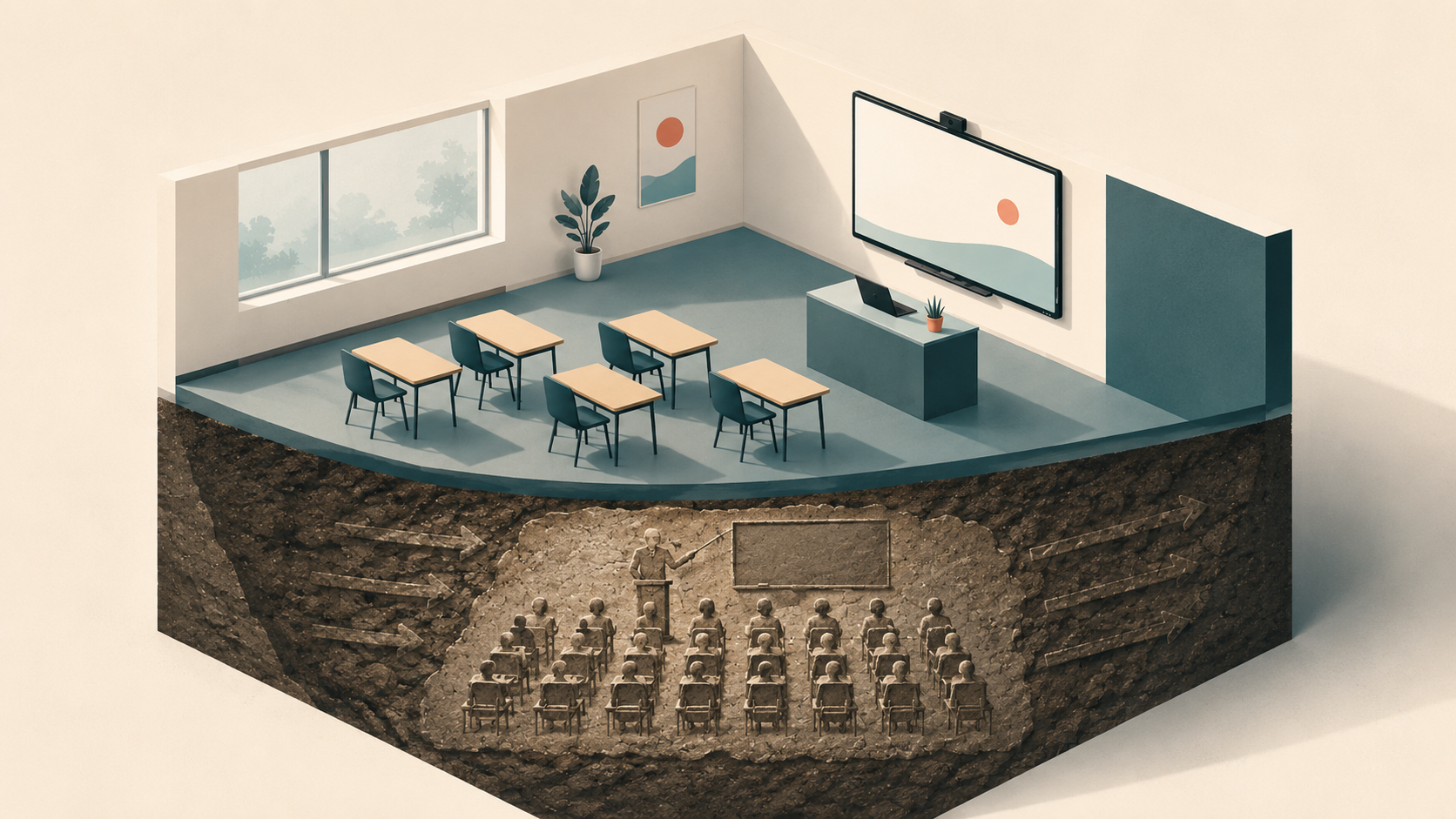
A fossilised culture is not the absence of change. It is change that circles around the same old assumptions.
The Classroom-Based Assessment Paradox
When the Blueprint and the Lesson Plan Do Not Speak
Take classroom-based assessment, for example. I genuinely admire the philosophy behind classroom-based assessment. It promotes continuous learning, formative feedback, holistic development, and learning beyond examinations. When I read the policy documents, I feel a small flutter of hope. The intent is real and the language is humane.
I was once part of the coaching team when classroom-based assessment was first introduced. Time, money, and energy were invested into training teachers across schools. Workshops were conducted. Coaching sessions were organised. Teachers were encouraged to move beyond examination centred teaching towards more meaningful and continuous assessment practices.
Yet years later, many educators quietly question whether the larger culture surrounding schools truly changed alongside the reform.
And yet, once students enter Form 5, I watch the atmosphere change dramatically. Seventeen year olds move from one trial paper to another. Modules. Drilling sessions. Endless drilling. Teachers worry about target results. Schools become anxious about rankings and performance indicators. Students memorise answering techniques and model essays simply to survive a high-stakes examination. The original spirit of meaningful learning slowly slips out of the room.
I do not blame anyone individually for this. Form 5 teachers know what is coming. Parents have watched cousins rejected from universities for a single B in Bahasa. School leaders are appraised on examination metrics. Everyone is responding rationally to a system that says one thing in its policy documents and rewards a very different thing in its actual incentives.
The Global Mirror
I Am Not Alone In Worrying About This
When I read what organisations such as the World Bank, UNESCO, and the OECD have been saying, I find the same concern echoed across many systems. Reforms get announced. Pedagogical language gets adopted. Classrooms remain, in their bones, examination-driven and pedagogically traditional. Malaysia is not uniquely guilty here. We are just, perhaps, unusually articulate about ambitions we have not yet structurally backed.
I take a strange comfort in knowing this is not only a Malaysian struggle. I also feel uneasy about that comfort. The pattern is global precisely because the conditions that produce it, reforms written by people who do not have to teach on Monday morning and implemented by people who do, are global as well.
The Reframe
A school can update everything except its assumptions and still produce yesterday's classroom inside tomorrow's building. The blueprint matters less than the unspoken rules about who speaks, who waits, who matters, and what counts as having learned something.
A Scene I See Often
The Classroom That Looks Sophisticated and Behaves Old
Let me describe a scene I have watched play out in many forms. A Form 3 classroom. Fluorescent lights. The teacher has a new laptop on the trolley, donated through a CSR programme. The slides are bright and well designed. There is a YouTube clip cued up. By any reasonable measure, the classroom has been digitalised.
And then I watch the next forty minutes. The teacher talks. Students listen. Slides advance. A clip plays. Students copy a definition. A question is asked, almost always a closed one, almost always answered by the same three students. The lesson ends. The teacher feels she has covered the chapter. The students feel they have got through another period. Technically, nobody has done anything wrong.
But also, I notice that almost nobody has thought hard about anything. Nobody has been confused out loud and worked through that confusion in real time with help. Nobody has been wrong in a way that became useful. Nobody has changed their mind. The classroom looked sophisticated. The pedagogy underneath it was, in everything that mattered, the same one that shaped my own school days decades ago.
What Technology Can and Cannot Fix
A whiteboard becoming a screen does not, by itself, make a lesson interactive. A printed worksheet becoming an online quiz does not, by itself, change what the quiz tests. A textbook becoming a PDF does not, by itself, change how it gets read. The container has changed. The content of the experience has not.
I have come to believe that without pedagogical transformation, digitalisation simply gives traditional teaching a sleeker interface.
"Meaningful transformation rarely begins through policy documents alone. It begins when enough of us start questioning what has long been accepted as normal."
The Whole Ecosystem
It Is Not Just The Teacher
I want to be very clear about something. I refuse the easy story that says teachers are resisting change, or worse, that teachers are stuck in their ways. That story lets policymakers off the hook. It lets parents off the hook. It lets the whole structure off the hook. From what I see daily, it is also mostly wrong.
Look at the daily life of a teacher in many of our schools. Administrative tasks. Documentation. Reporting systems. Intervention paperwork. Meetings. KPIs. Co-curricular obligations. Examination preparation. Somewhere in the cracks of all of this is the actual work of designing a lesson that makes a thirteen year old think differently about photosynthesis. We have built a profession that does not protect the cognitive space pedagogy actually requires.
Above the teacher sits a school leader who is also being measured. GPS rankings. SPM performance bands. Documentation audits. I have spoken to leaders who genuinely believe in deep learning, yet still have a school to keep afloat in an evaluation system that rewards other things. So they do what most of us do under that kind of pressure. They protect the metrics that get measured and quietly let the other things drift.
The Whole Village Problem
As long as university entry treats SPM as the only currency, as long as parents compare schools by ranking tables, as long as KPIs reward measurable outputs over meaningful learning, I cannot in good conscience place the burden of cultural transformation on a single teacher in a single classroom. That is asking them to swim against an entire river. Some still do. Most exhaust themselves trying. The river keeps flowing.
Professional development sits inside the same river. I have watched teachers attend countless workshops, courses, webinars, and sharing sessions. They collect certificates. They present at innovation competitions. Then they return to Monday morning, and Monday morning has not changed. Not because the workshop was bad, but because we have built no structural time, and no real permission, for teachers to rebuild their practice once they get back.
What Care Actually Means Here
Care Is Not a Soft Skill. It Is a Structural Decision.
When I talk about reform, I notice we often drift towards the language of kindness. Teachers should care more. Schools should be warmer. Students should feel seen. None of this is wrong. All of it is insufficient, and I want to say so plainly.
Care, in the way I mean it here, is not a feeling. It is a structural decision. It is what we put on the timetable. It is what survives the appraisal cycle. It is what leadership protects when the audit arrives. A school that says it cares about thinking and then drills past every opportunity to think because the trial paper is in three weeks has not made a caring decision. It has made a survival one. I have made some of those decisions myself, and I do not pretend otherwise.
The honest question I want institutions to sit with is not whether their teachers care. Most do, and it costs them. The honest question is whether the institution has built a place where that care can actually translate into pedagogy without being punished for the time it takes.
"Perhaps the greatest tragedy is not that schools resist change, but that many students continue experiencing yesterday's schooling inside tomorrow's world."
For all of this, I do not end in despair, and I do not think you should either. Across Malaysia, in places that almost never make the showcase reels, I keep meeting teachers who have figured out how to do this work anyway. They run classrooms where students argue with each other and with the text. They build psychological safety on purpose. They use action research not as a competition entry but as genuine reflection on their own practice.
They would refuse the label of heroes, and I think they are right to. They are simply educators who have decided, against the gravitational pull of the system, that they will not run a classroom they themselves would have hated to sit in. They tend to be tired. They tend to be impatient with policy language. When I speak to their former students, years later, these are the teachers those students still remember.
The fossil, I keep reminding myself, is not eternal. It is just very heavy. And it gets a little lighter each time a teacher, a school leader, a parent, a SISC+ officer, a Ministry official, decides the real question is no longer whether to add another initiative, but whether to challenge a habit that everyone has stopped noticing.

Join the Conversation
What did this piece stir up for you? Share a reflection, a disagreement, a classroom story, or a question worth sitting with.